
From Fragmented Tools to One Operations Platform
A practical roadmap for consolidating project, HR, and time-tracking tools without disrupting the teams that rely on them.

Overview
Tool sprawl is the natural result of good local decisions. Each team picked the best tool for its own job: one for projects, one for HR requests, one for timesheets, one for internal chat about all three. Every individual choice was defensible. The combined result is an operations stack where no system knows the whole story and people become the integration layer, copying information from one tool into another.
Consolidating that stack is one of the highest-leverage operational projects a growing company can run, and also one of the easiest to fumble. This article lays out a sequence that works.

- Map the workflows, not the tools, and find where information crosses system boundaries.
- Consolidate around the record of work, the shared core that projects, people, and time all touch.
- Migrate one workflow at a time, with a hard cutover date for each.
Map Workflows Before Touching Tools
Start by following two or three real workflows end to end, for example a new hire's first week, or a project from approval to invoice. Write down every system the workflow touches and every point where a person moves data between systems by hand. Those crossing points are where errors, delays, and duplicate work live, and they are the case for consolidation.
This map also tells you what you can safely leave alone. A specialist tool that no workflow crosses into, such as a design tool used only inside the design team, is not causing fragmentation pain and does not need to be part of the project.
Choose the Core, Then Sequence the Moves
Effective consolidations pick a core, the platform that will hold the shared record of work, and move workflows onto it in order of pain. Platforms like Workefy that unify project planning, HR workflows, and time tracking are designed to be that core: when tasks, people, and hours live in one system, the copy-paste layer between them simply disappears.
Sequence matters more than speed. Move the workflow with the worst duplication first, prove the benefit, and let that success pull the next migration along.
Bring People Along, Not Just Data
Consolidation projects fail socially more often than technically. Every tool being retired has someone who chose it, configured it, and built their routines around it. Treat those people as the experts they are: involve them in mapping the workflow, let them pressure-test the new setup, and give them credit when the migration lands. A consolidation that is done to a team will be resisted; one done with the team becomes self-sustaining.
It also helps to be explicit about what people gain personally: fewer logins, fewer places to update the same fact, and an end to being the human bridge between systems. Abstract efficiency arguments persuade nobody; removing a daily annoyance persuades everyone.
- Prepare each migration:
- Clean the data before it moves; do not import years of stale records.
- Name an owner for the workflow in the new system.
- Agree what the old tool will stop doing, and when.
- Run a real cutover:
- Set a date after which the old tool is read-only, because parallel running never ends on its own.
- Keep the old system accessible for reference during a defined wind-down.
- Fix teething problems in the new system rather than retreating to the old one.
- Consolidate the gains:
- Cancel the retired licenses; the savings fund the next phase.
- Rebuild reports on the unified data, where they no longer need manual assembly.
- Document the new workflow while the change is fresh.

What Changes When You Are Done
The benefit of consolidation is not a shorter tool list. It is a shorter path from question to answer.
After consolidation, a manager checking whether a project can absorb more work looks in one place, because the plan, the team's availability, and the hours already spent share a system. Onboarding a new hire sets up one account, not five. That only holds if hiring and the people record share a platform — see how applicant tracking systems actually work for where the hand-off usually breaks, and what an HRIS holds once the hire lands. Reporting stops being a monthly assembly job and becomes a live view.
None of this requires a big-bang replacement of everything at once. Map the workflows, pick the core, move the most painful workflow first, and cut over cleanly each time. Consolidation done this way builds trust as it goes, and the organization ends up with an operations platform it actually uses, rather than one more tool on the pile.
Related reading
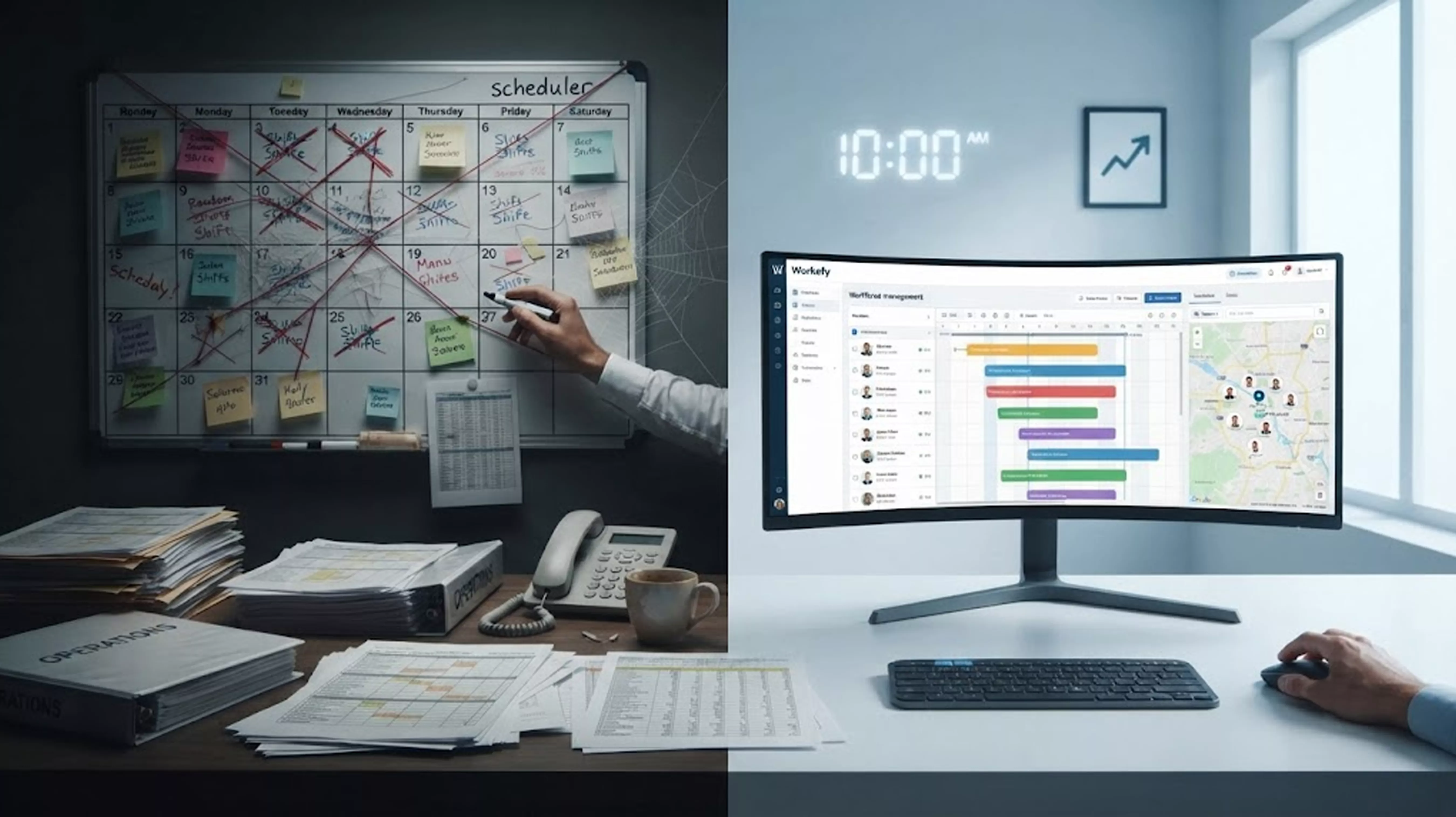
Why Manual Resource Scheduling Is the Hidden Tax on Your Service Business
Learn more →
AI Business Operations Platform: The Future of Connected Workplaces
Learn more →Is Employee Monitoring Legal? Consent, Scope, and Records
Learn more →Want to see how this works in practice?
Tell us how your team runs today and we'll walk you through the parts of Workefy that apply.
Prefer email? Write to contact@workefy.io