
AI Business Operations Platform: The Future of Connected Workplaces
Discover how an AI business operations platform helps organizations manage projects, HR, hiring, time tracking, workflow automation, and AI assistants in one connected workplace.

Modern businesses don't struggle because they lack software. They struggle because they have too much of it.
One application manages projects. Another tracks customer relationships. HR has its own platform, while hiring, attendance, and employee records live somewhere else. Teams communicate across multiple messaging apps, and critical business information often ends up in spreadsheets that quickly become outdated.
Each tool may perform its job well. The real challenge begins when the business needs all those tools to work together.
As organizations grow, disconnected software creates operational silos, duplicate data, manual processes, and delayed decision-making. Employees spend more time switching between applications than completing meaningful work.
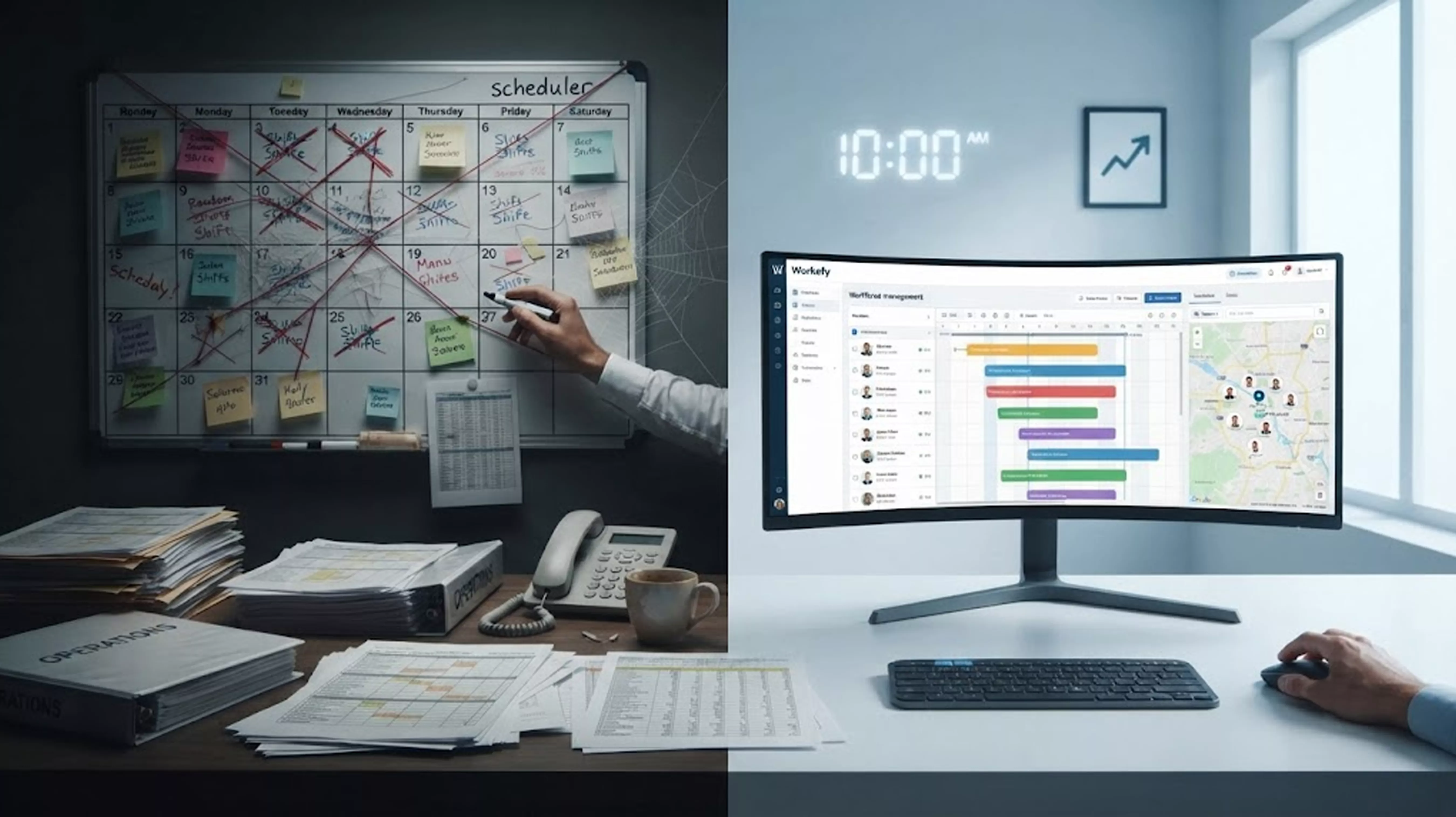
This is why businesses are increasingly adopting AI business operations platforms—centralized workplace solutions that connect planning, HR, hiring, time management, workflow automation, AI assistants, and business insights into one intelligent ecosystem.
Rather than replacing every specialized tool, an AI business operations platform connects the workflows that keep your organization moving, giving teams a shared view of work while reducing administrative overhead.
What Is an AI Business Operations Platform?
An AI business operations platform is a unified workplace management system that combines multiple business functions into one connected environment while using artificial intelligence to automate repetitive work, provide actionable insights, and improve decision-making.
Unlike traditional software that focuses on a single department, an AI operations platform brings together essential business capabilities such as:
- Project Planning
- Task Management
- HR Management
- Hiring & Recruitment
- Employee Time Tracking
- Workflow Automation
- AI Assistants
- Business Dashboards
- Reporting & Analytics
Instead of forcing employees to move between multiple disconnected applications, an AI-powered workplace provides one central source of truth for business operations.
The result is greater visibility, improved collaboration, and fewer manual processes.
Why Growing Businesses Outgrow Disconnected Software
Every growing organization follows a similar technology journey.
Initially, one project management tool is enough. As the company expands, additional software is introduced:
- CRM software for sales
- HR software for employee management
- Hiring software for recruitment
- Time tracking software
- Reporting dashboards
- Workflow automation tools
- Communication platforms
- Shared spreadsheets
Over time, what began as a simple technology stack becomes increasingly fragmented.
The problem isn't having multiple applications. The problem is that those applications rarely communicate effectively with one another.
Teams often spend valuable hours:
- Copying information between systems
- Updating multiple records manually
- Exporting spreadsheets
- Creating reports
- Searching for missing information
- Following up across departments
These repetitive activities slow productivity and increase the risk of errors.
An AI business operations platform helps eliminate these operational gaps by connecting teams, processes, and data into one intelligent workplace.
Signs Your Business Has Outgrown Its Current Software
Many organizations don't realize that disconnected systems are limiting growth until productivity begins to decline.
You may have outgrown your current software if your business experiences any of the following:
- Employees regularly switch between multiple applications to complete one task
- Information is duplicated across different systems
- Reports require manual spreadsheet work every week
- Managers struggle to get real-time business insights
- Departments operate independently with limited visibility
- Project updates are frequently delayed
- Employee information exists in multiple locations
- Hiring workflows involve excessive manual coordination
- Teams spend more time managing software than serving customers
If these challenges sound familiar, it may be time to move toward a connected workplace platform.
Why Businesses Are Choosing AI-Powered Workplace Platforms
1. A Single Source of Truth
One of the biggest advantages of an AI workplace platform is centralized information.
Instead of searching through multiple applications, employees can access projects, people, hiring pipelines, operational data, and AI-powered insights from one connected workspace. This improves transparency across departments while reducing confusion caused by outdated information.
2. Better Project Planning and Execution
Successful businesses rely on effective planning. Modern project management software should do more than organize tasks.
An AI-powered planning platform helps teams:
- Plan projects
- Prioritize work
- Track milestones
- Monitor workloads
- Identify bottlenecks
- Forecast delivery timelines
- Improve team collaboration
AI can also summarize project updates, identify risks, and surface overdue tasks before they become larger problems.
3. Smarter HR and Workforce Management
People are every organization's greatest asset. Managing employees across multiple spreadsheets and disconnected systems quickly becomes inefficient.
Integrated HR software allows organizations to manage:
- Employee records
- Leave requests
- Attendance
- Performance tracking
- Organizational structures
- Workforce planning
With AI assistance, HR teams can automate repetitive administrative work while focusing more on employee development and engagement.
4. Streamlined Hiring and Recruitment
Recruitment involves multiple moving parts—from job postings and candidate screening to interviews and onboarding.
Hiring software integrated into a business operations platform helps organizations:
- Manage candidates
- Track recruitment pipelines
- Coordinate interviews
- Centralize applicant information
- Reduce manual follow-ups
AI can assist by summarizing candidate profiles, identifying required skills, and helping recruiters prioritize applicants more efficiently.
5. Accurate Time Tracking
Understanding how time is spent across teams helps organizations improve planning and resource allocation.
Modern time management software enables businesses to:
- Track work hours
- Monitor productivity
- Manage timesheets
- Support payroll preparation
- Improve project costing
When connected with planning and HR systems, time tracking becomes significantly more valuable.
6. Workflow Automation That Eliminates Repetitive Work
Administrative work consumes thousands of hours every year.
Workflow automation helps reduce repetitive tasks by automatically triggering actions when specific conditions are met.
Examples include:
- Creating tasks automatically
- Sending approval requests
- Notifying stakeholders
- Updating project status
- Assigning work
- Generating reports
- Sending reminders
- Escalating overdue items
Automation doesn't replace people. It removes repetitive work so employees can focus on higher-value activities.
7. AI Assistants That Help Teams Work Smarter
Artificial intelligence is changing how employees interact with workplace software.
Instead of searching across multiple systems, AI assistants can instantly retrieve information, summarize projects, answer workplace questions, and generate insights.
AI assistants can help users:
- Summarize meetings
- Review project progress
- Find company information
- Generate reports
- Identify operational risks
- Answer HR-related questions
- Analyze business performance
- Recommend next actions
Rather than replacing human decision-making, AI supports employees by delivering relevant information faster.
AI Business Operations Platform vs Traditional Business Software
- Traditional Business Software: Separate applications for every department, Manual data transfers, Static reporting, Limited automation, Employees search for information, Department-specific visibility, Disconnected processes.
- AI Business Operations Platform: Connected workplace ecosystem, Shared data across modules, Real-time dashboards, Intelligent workflow automation, AI assistants retrieve information instantly, Organization-wide insights, Unified operational workflows.
The shift isn't about replacing every existing application. It's about creating a connected environment where information flows naturally between teams.
The Benefits of a Connected Workplace
Organizations adopting integrated workplace management software often experience improvements in several key areas.
- Improved Collaboration: Shared information reduces communication gaps between departments.
- Faster Decision-Making: Real-time dashboards provide managers with current operational insights.
- Greater Productivity: Employees spend less time switching between systems and more time completing meaningful work.
- Reduced Administrative Work: Automation minimizes repetitive manual processes.
- Better Employee Experience: Connected systems make everyday work simpler and more efficient.
- Scalable Operations: As businesses grow, connected software scales more effectively than disconnected applications.
Why Modular Software Is the Future
Every organization has different operational needs. Some businesses primarily need project planning. Others require hiring, HR, or time management.
Rather than forcing organizations into large, complex software suites, modular workplace platforms offer greater flexibility. Businesses can start with the products they need today and expand as requirements evolve.
This approach reduces implementation complexity while protecting future growth. It also allows organizations to introduce new capabilities without replacing their existing workflows.
Why Workefy?
Workefy is an AI-powered workplace platform designed to simplify how modern organizations manage work.
Instead of offering isolated software products, Workefy provides a connected suite of workplace solutions that work brilliantly on their own—and even better together.
Organizations can choose the modules that fit their current needs, including:
- Planning
- HR
- Hiring
- Time
- AI Assistants
As business requirements evolve, additional products can be added without disrupting existing workflows.
For agencies, software providers, and enterprise organizations, Workefy also offers white-label capabilities, making it possible to deliver a branded workplace platform without building one from scratch.
Whether you're managing projects, employees, recruitment, or business operations, Workefy provides the flexibility to grow at your own pace.
Why Businesses Are Investing in AI Business Operations Platforms
Digital transformation is no longer just about adopting new software. It's about connecting people, processes, and information in ways that improve productivity and decision-making.
Organizations that continue relying on disconnected systems often face increasing operational complexity as they grow.
By contrast, businesses using connected AI workplace platforms gain:
- Better operational visibility
- Faster collaboration
- Smarter planning
- Automated workflows
- Improved employee experiences
- AI-powered insights
- Greater business agility
The future of work isn't about using more software. It's about using smarter software that works together.
Frequently Asked Questions
What is an AI business operations platform?
An AI business operations platform is a centralized workplace solution that combines project management, HR, hiring, time tracking, workflow automation, reporting, and AI assistants into one connected system.
How is an AI operations platform different from ERP software?
Traditional ERP systems primarily focus on finance and resource planning. AI business operations platforms emphasize collaboration, workplace productivity, automation, employee experience, and intelligent decision support while integrating multiple operational functions.
Can small and medium-sized businesses benefit from AI workplace software?
Yes. Modular platforms allow businesses to start with the products they need and expand over time, making them suitable for startups, growing businesses, and large enterprises alike.
Does AI replace employees?
No. AI is designed to automate repetitive tasks, provide insights, and support better decision-making. Human expertise remains essential for strategy, creativity, and relationship building.
What business functions can be managed in one platform?
A modern AI workplace platform can manage planning, projects, HR, hiring, employee time tracking, workflow automation, dashboards, reporting, and AI-powered assistance.
Is modular workplace software better than buying everything at once?
For many organizations, yes. A modular approach lets businesses implement only the capabilities they need today and add more products as they grow, reducing complexity and supporting long-term scalability.
Ready to Build a More Connected Workplace?
Managing projects, employees, recruitment, time, and business operations shouldn't require switching between dozens of disconnected tools.
Workefy brings together the essential workplace solutions businesses need in one AI-powered platform—helping teams plan smarter, collaborate better, automate repetitive work, and make more informed decisions.
Start with a single product, expand as your business grows, and create a workplace where every team works from the same connected ecosystem.
Explore Workefy today and discover how an AI-powered workplace platform can help your organization simplify operations, improve productivity, and prepare for the future of work.
Questions we get asked
An AI business operations platform is a centralized workplace solution that combines project management, HR, hiring, time tracking, workflow automation, reporting, and AI assistants into one connected system.
Related reading

Want to see how this works in practice?
Tell us how your team runs today and we'll walk you through the parts of Workefy that apply.
Prefer email? Write to contact@workefy.io