
Why Manual Resource Scheduling Is the Hidden Tax on Your Service Business
Discover why manual resource scheduling is the hidden tax on your service business and how automated workforce management can solve it.
Introduction
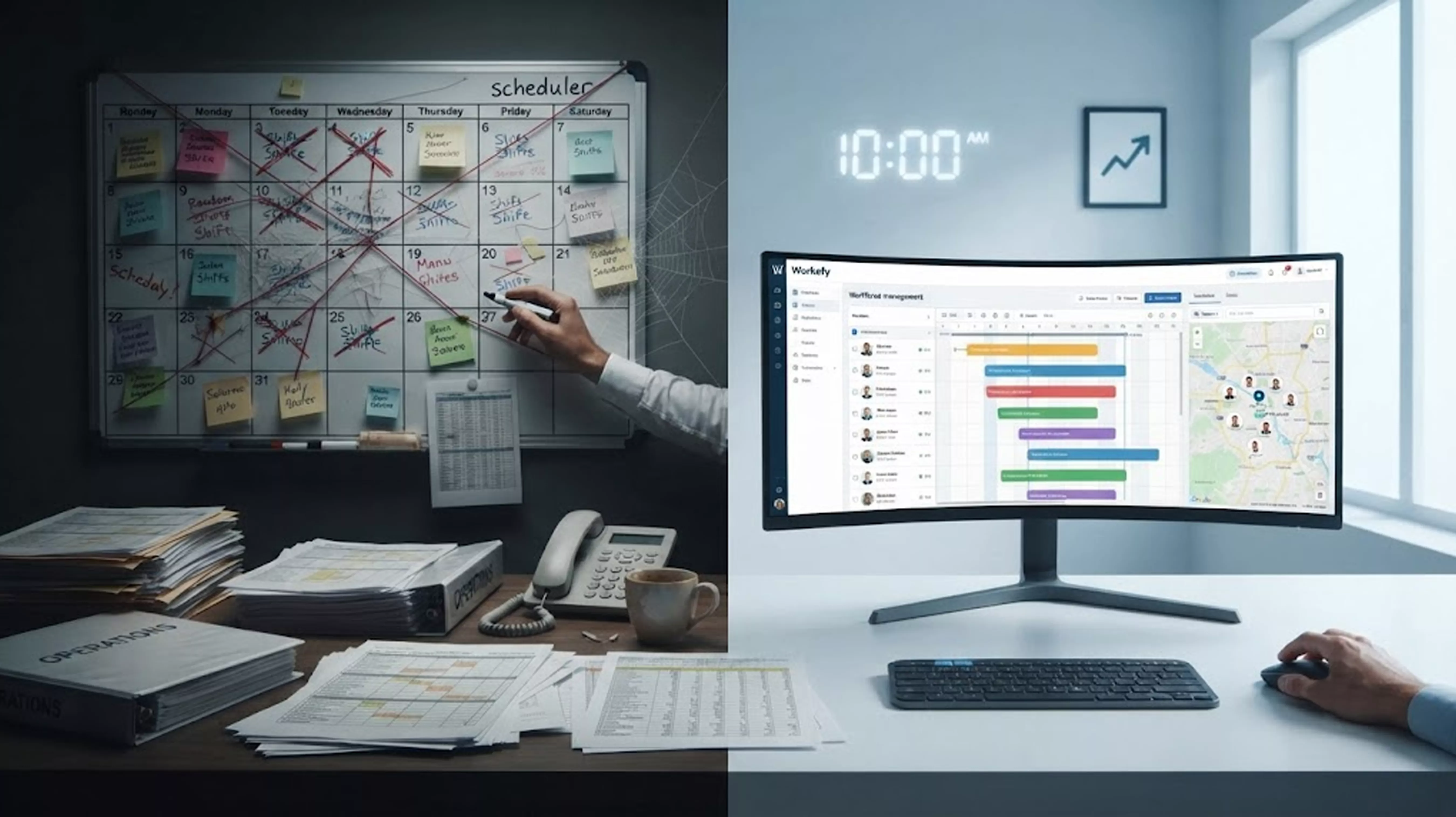
In most mid-sized service businesses, resource scheduling is handled through a fragile combination of spreadsheets, whiteboard calendars, WhatsApp groups, and email threads. The person doing the scheduling knows the system intimately. When they are unavailable, the system breaks.
This is not a small operational problem. The hours spent coordinating who goes where, which team handles which job, whether a technician's certification matches the task requirements, and who is available for emergency dispatch compound into a massive management overhead burden every week. Worse, the inevitable errors, missed assignments, double-bookings, and inefficient routing don't just cost time. They cost client trust and direct margin.
This post covers why manual resource scheduling stays in place longer than it should, what automated scheduling software looks like when implemented cleanly, and how transitioning to workforce management software fundamentally changes the scalability of a service operation.
Why Manual Scheduling Persists
The honest answer to why service businesses resist resource scheduling automation is that manual scheduling feels familiar and, in the short term, flexible. The scheduler has developed heuristics over years that work most of the time. The edge cases—a technician calling in sick, a client requesting a specific crew—are handled by memory and experience. The system feels personal in a way that software initially does not.
The structural problem is that this institutional knowledge is not documented, not transferable, and not scalable. When the core scheduling function is entirely dependent on one person rather than a system, the business cannot grow faster than that person can process information. The business also carries an immense single-point-of-failure risk if that person leaves or takes extended leave.
There is also a severe data visibility problem. Manual scheduling produces no structured historical data. You cannot reliably analyze which technician types close specific job categories fastest. You cannot see whether scheduling decisions are creating commute time inefficiencies that are eroding margins across a quarter. You cannot identify which geographic zones are consistently underserved or overstaffed. Capacity planning software requires structured data; manual scheduling produces only noise.
What True Resource Scheduling Automation Requires
Clean transition to automated shift scheduling and resource management requires three data foundations that manual systems typically lack. This is the difference between simply buying workforce management software and actually automating the workflow:
- Structured Resource Profiles. Every technician, contractor, or team member needs a structured data profile: their specific skills, valid certifications (including expiration dates), standard working hours, geographic service zones, and real-time workload capacity. Automated scheduling software can only optimize against data that exists in a queryable format.
- Structured Job Requirements. Every job ticket needs defined parameters: the exact skill requirements, the estimated duration based on historical averages, the location coordinates, the client priority SLA, and any compliance or equipment constraints. A job description written in a free-text notes field cannot be processed by scheduling algorithms.
- Integration Between HR and Operations. Leave requests, shift changes, PTO, and capacity constraints need to flow automatically into the scheduling layer. If the scheduler has to manually check a separate HR system to see if someone is on leave before assigning a job, the efficiency gain from the scheduling software is partially lost to manual coordination overhead.
The Workefy Approach to Automated Scheduling
Workefy is designed as the best resource scheduling software for businesses that need to bridge the gap between complex human operations and automated efficiency. Workefy connects HR, project management, and operational data into a single scheduling context.
When a new job is created in Workefy, the system evaluates available resources against the specific job requirements—matching skills, geographic proximity, and availability—and surfaces the most optimized assignment options. When a resource unexpectedly becomes unavailable, affected assignments are flagged for reassignment immediately, rather than discovered hours later when the job is missed.
Crucially, managers retain full control over final assignment decisions. The system handles the complex information synthesis—checking schedules, verifying skills, calculating routes—that currently requires hours of manual effort, allowing the manager to approve the optimal schedule in minutes.
Conclusion
The transition from manual whiteboards to workforce management software is not simply a software purchase. It is a data structuring initiative followed by an operational shift. The organizations that successfully implement shift scheduling automation invest the time upfront to clean their resource profiles and define their job parameters. The organizations that skip that step end up using an expensive software platform as just another digital whiteboard.
When implemented correctly, resource scheduling automation eliminates the administrative bottleneck holding back your growth. It transforms scheduling from a full-time stress position into a streamlined management approval process.
If you are evaluating capacity planning software or want to understand how Workefy can map to your specific service operation, we are happy to walk through your current scheduling process and identify where the highest-leverage automation opportunities exist.

Want to see how this works in practice?
Tell us how your team runs today and we'll walk you through the parts of Workefy that apply.
Prefer email? Write to contact@workefy.io